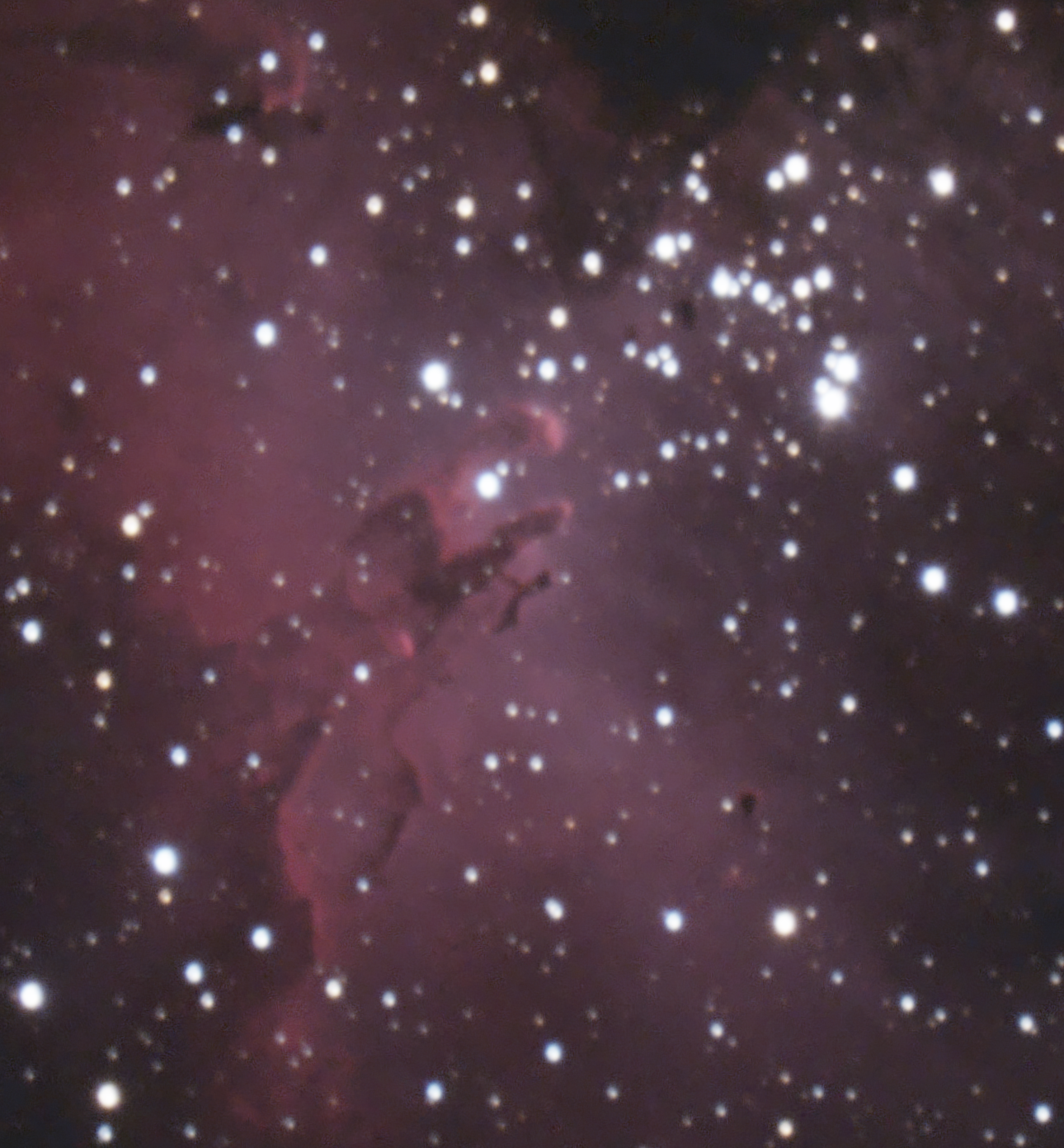
M16 & NGC6611
Notes
[ZWO ASI2600MC Pro]
CameraSerialNumber=2B35920208010900
FrameType=Light
Debayer Preview=Off
Pan=0
Tilt=0
Output Format=FITS files (*.fits)
Binning=1
Capture Area=6248x4176
Colour Space=RAW16
Exposure/Gain Shift=0
Hardware Binning=Off
High Speed Mode=Off
Turbo USB=100(Auto)
Flip=None
Frame Rate Limit=Maximum
Gain=100
Exposure=180,000s
Apply Time Offset (ms)=0
Timestamp Frames=Off
White Bal (B)=50
White Bal (R)=50
Brightness=50
Window Heater Power=Off
Cooler Power=63
Temperature=-4,8
Target Temperature=-5
Cooler=On
Auto Exp Max Gain=100
Auto Exp Max Exp MS=10000
Auto Exp Target Brightness=50
Mono Bin=Off
CA Reduction/Synthetic Blue=Off
Mask over exposed pixels=Off
Flip (after dark/flat)=None
Trail Width=3
Minimum Trail Length=100
Trail Detection Sensitivity=9
Remove Satellite Trails=Off
Background Subtraction=Off
Planet/Disk Stabilization=Off
Banding Threshold=10
Banding Suppression=0
Apply Flat=None
Dark Scaling (Experimental)=Off
Hot Pixel Sensitivity=5
Subtract Dark=None
DisplayStretchEnable=1
NegativeDisplay=0
Display Black Point=0,0182037353515625
Display MidTone Point=0,0433642582727114
Display White Point=0,9999847412109375
Notes=
ZWO Focuser (2)=25425
Focuser Temperature=27,540000915527344
EQMOD ASCOM HEQ5/6=RA=18:20:13,3,Dec=-12:04:53 (J2000)
TimeStamp=2026-08-21T21:49:36.7323413Z
SharpCapVersion=4.1.14310.0
LastPlateSolveData=Plate solve result was RA=18:18:40,4,Dec=-13:51:30 with mount at RA=18:20:16,3,Dec=-12:04:54, FOV 0,694x0,694 degrees, up is 189,61 degrees East of North
Object Information
Messier 16 (M16), the Eagle Nebula, is an active star-forming region in the constellation of Serpens. Its central young open cluster, NGC6611, illuminates the surrounding hydrogen-rich gas, while dark lanes of interstellar dust sculpt the famous Pillars of Creation visible in the image.
These dense columns of gas and dust are sites of ongoing stellar birth, concealing young stars within the nebula. M16 combines the emission nebula IC4703 and the open cluster NGC6611; the cluster was first observed by Jean-Philippe Loys de Chéseaux in 1745–1746, while Charles Messier recorded the nebula in 1764.